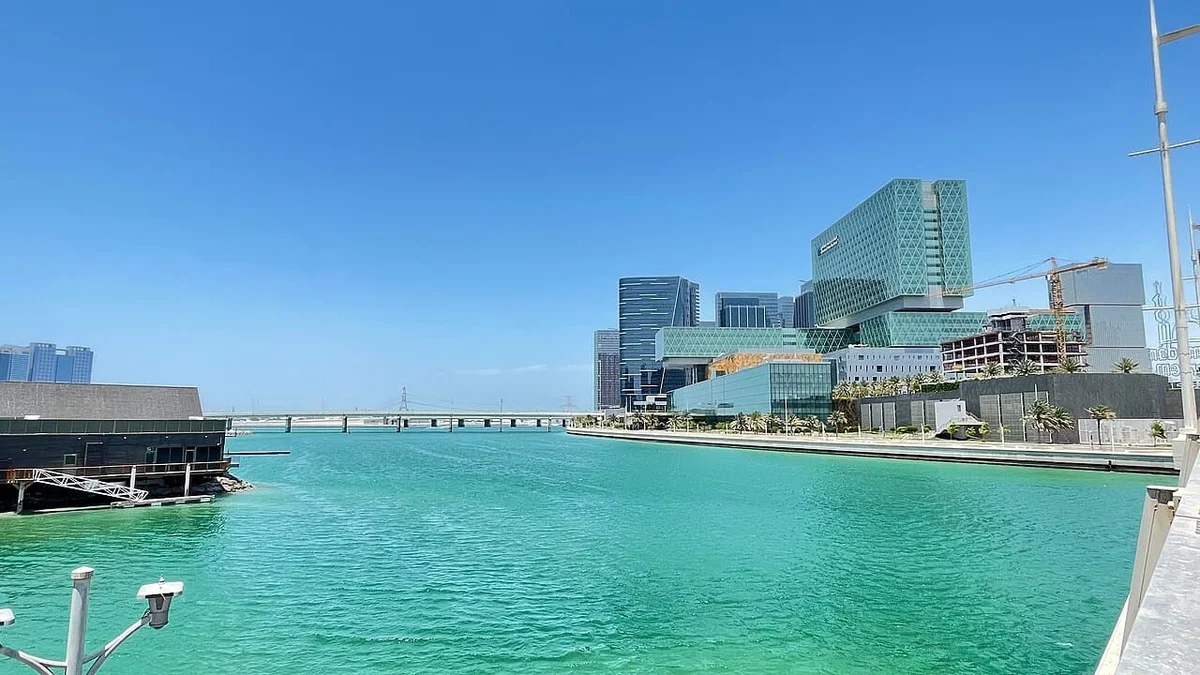
Al Maryah Island is sold as Abu Dhabi’s financial district, which is accurate and which buries the thing that actually makes it different from every other address in the emirate. The difference is not the tenant profile or the walk to work. It is the law.
Abu Dhabi Global Market sits on this island, and ADGM is not a business park with a good name. It is a jurisdiction, with its own courts, its own procedure and a legal system built on common law rather than on the civil law that governs the mainland. An investor buying here is buying into a place where the answer to “what happens if the tenant stops paying” can be a different answer from the one that applies four kilometres away.
Which legal system governs a lease on this island?
Not automatically the one that governs the rest of Abu Dhabi. ADGM operates a common law system with its own courts and its own published procedure, and property and contracts falling inside its jurisdiction answer to that system rather than to the mainland framework.

The word doing the work in that sentence is “falling”. Whether a particular lease, a particular title or a particular dispute falls inside ADGM is a question with a specific answer for a specific asset, and it is not answered by the island’s name. It turns on where the property sits relative to a boundary set by decree, on which register the title is recorded, on who the parties are, and on what the contract itself says about governing law and forum. Every one of those is checkable. None of them is checked by a buyer who has read a brochure describing the district as Abu Dhabi’s financial centre and concluded that the emirate’s rules apply as normal. The company formation side of the same jurisdiction is covered on the ADGM setup page.
What does the choice of forum actually change for a landlord?
It changes everything downstream of a default. Rent is a promise, and a yield is a forecast about how reliably that promise converts into money. The conversion mechanism is the legal system, so changing the legal system changes the forecast.
| What you are underwriting | Where the answer comes from | Why it moves here |
|---|---|---|
| Time to recover possession | Forum procedure and listing practice | A different court with different rules |
| What the lease can validly say | Governing law of the contract | Common law drafting permits terms civil law handles differently |
| Whether a rent review binds | The clause plus the governing law | Review mechanics are contractual, not imposed by a published index |
| Cost of enforcing | Forum fees and representation | Priced per forum, not per emirate |
| Who your counterparty legally is | The entity, not the occupant | Corporate leases sit behind a company, not a person |
None of the rows in that table is a reason to avoid the island. Several are reasons to prefer it, for a landlord who has read the lease and structured it on purpose. The point is that the table has to be filled in for the specific asset, and almost no purchase here fills it in at all.
Buying on Al Maryah and unsure which framework applies?
Send us the building and the lease. We will tell you what to establish in writing before exchange and who has to confirm it.
Where does the boundary run, and why is that a live question?
Along a line set by decree, which has been amended and can be amended again. A jurisdiction whose geography is defined by instrument is a jurisdiction whose geography is capable of changing, and the instruments are public while the marketing material is silent about them.
The practical effect is that “on Al Maryah” and “inside ADGM” are two statements that a buyer should not treat as one. Confirm the second in writing for the specific building rather than inferring it from the first. This also has a forward-looking dimension worth understanding before committing capital, because a boundary that has moved once is a boundary that the emirate has demonstrated it will move again when policy calls for it. That is not a risk in the ordinary sense. It is a variable in the deal that most investors do not know is a variable, and the ones who have surfaced it hold a position they can explain when something goes wrong. The residential island next door and its own quite different fragmentation problem sits on the Al Reem page.
Who is the tenant, and why does that change the underwriting?
A company, more of the time than anywhere else in Abu Dhabi. The tenant on a residential floor here is frequently an employer taking the unit for a person rather than the person taking it for themselves.
A corporate covenant is a different instrument from an individual one and it fails in a different way. While the entity is trading it is stronger than a salaried tenant, because it is not exposed to one person losing one job. When it stops trading, or when it restructures, or when the secondment ends early, the exit is contractual and fast rather than personal and slow. The credit assessment is accounts rather than a salary certificate. The negotiation includes break clauses, assignment rights and reinstatement obligations that an individual tenant has never heard of, and a landlord who accepts a template lease from a corporate tenant’s counsel has accepted a set of options they did not price. This is the specific way the island rewards preparation: the tenant is better and the contract is harder.
What breaks when you model this like the rest of the emirate?
The comparison itself. Al Maryah is habitually benchmarked against other Abu Dhabi addresses on price per square foot and a yield band, and both sides of that comparison assume a common enforcement environment that is exactly what is in question.
A model built that way carries a hidden term. It prices the asset on emirate-wide rent evidence, applies an emirate-wide void assumption, and then assumes an emirate-wide recovery process behind the void assumption. On this island the third term is the one that does not transfer, and it is invisible because nobody writes it down. The correct approach is to keep the rent evidence, which is real, and to rebuild the enforcement assumptions from the specific forum that will actually hear a dispute on the specific asset. Where the underlying Abu Dhabi rent and yield evidence is assembled, and how to read it, is set out on the Abu Dhabi investment guide and the freehold areas page.
What should the lease itself say?
Three things, explicitly, in every lease you grant or inherit here. The governing law. The dispute forum. The mechanism for service of process on the counterparty.
Templates leave all three implicit, and an implicit answer is the worst of the available outcomes because it is discovered under pressure. A landlord who has written the governing law into the contract knows what remedies exist before needing one. A landlord who has named the forum knows what enforcement costs and how long it takes. A landlord who has fixed service of process against a corporate tenant with an address elsewhere has removed the single most common practical obstacle to enforcing anything at all. None of this is expensive at the drafting stage and all of it is expensive later. The same logic applies to how your own estate is structured against a property in a common law jurisdiction, which is worked through on the DIFC and ADGM wills page.
What does due diligence look like here in practice?
Four written confirmations, obtained before exchange, none of which appears on a standard checklist.
First, which register the title sits on, and what that means for mortgage registration and for enforcement against the title. Second, the boundary position of the specific building against the current decree. Third, the governing law and forum named in every lease you are taking over. Fourth, the owners association budget with the contract chain behind its largest lines, because a service charge is a set of contracts and the rate is only the output. A buyer holding those four is buying a known asset. A buyer holding a brochure and a yield band is buying a district.
Who should not buy on Al Maryah?
An investor who wants a passive residential yield and has no appetite for reading a commercial lease. That is a legitimate position and this is the wrong island for it.
The characteristics that make Al Maryah interesting are the same ones that make it demanding: a corporate tenant base that negotiates, a legal environment that has to be established rather than assumed, and a service charge structure attached to premium buildings. An investor who wants the returns without the reading has bought the demands and left the advantages on the table, because every advantage here is contractual and contracts only help the party that shaped them. An investor prepared to instruct properly and to hold documents rather than impressions is buying something that very few Abu Dhabi addresses offer, which is a position they can actually enforce.
Frequently Asked Questions
Because jurisdiction decides what every other number is worth. A yield is a forecast of rent collected, and rent collected depends on what happens when a tenant stops paying: which forum hears it, on what law, and how long it takes. Al Maryah is the address in Abu Dhabi where those answers are least like the rest of the emirate, so a model built on emirate-wide assumptions is being applied to the one place they were not drawn from.
That depends on the property, the parties and what the contract says, which is precisely why it is a due diligence question rather than a fact about the island. ADGM operates its own courts applying a common law system on the island, and mainland Abu Dhabi forums exist alongside them. A buyer needs the answer for the specific building and the specific lease in front of them, in writing, before exchange.
Not necessarily, and this is the check most buyers skip. ADGM maintains its own real property framework and its own registration arrangements for property inside its jurisdiction, distinct from the mainland Department of Municipalities and Transport register. Establishing which register your title sits on, and what that means for mortgage registration and for enforcement, belongs at the start of the process rather than at the trustee appointment.
The geographic jurisdiction is set by decree and it has been amended, so the honest instruction is to verify the current boundary against the building rather than to assume island-wide coverage. Two towers a short walk apart can sit on different sides of a line that no marketing material shows, and the difference changes which law governs the lease and which forum enforces it.
The counterparty is frequently a company rather than a person, and a corporate covenant behaves differently from an individual one. It is stronger while the entity trades and it disappears differently when the entity does not, it is assessed on accounts rather than on salary certificates, and it negotiates lease terms that an individual tenant would never raise. Underwriting a corporate tenancy on residential assumptions is the common error here.
Neither on its own, and treating it as a safety label is the mistake. A common law forum with published procedure is a real advantage for a landlord who has read the lease and structured it deliberately. It is no advantage at all to a landlord who signed a template, does not know which forum the template names, and finds out when they need to enforce something.
Four documents: written confirmation of which register the title sits on, written confirmation of the governing law and dispute forum in the lease you are taking over or granting, the owners association budget with the contract chain behind its largest lines, and the boundary position of the specific building. All four are obtainable before exchange and none is obtainable cheaply afterwards.
What is the search demand telling you about this district?
Al Maryah Island draws about 40 property searches a month, half of it on al maryah island apartments for sale. The investment phrasing measured zero, as it did across every district in the study, and our own Search Console data shows two impressions, which means the page is barely being surfaced at all.
Both figures point the same way. This is a district reached through Abu Dhabi rather than through its own name, and its page earns its place by serving a buyer who already knows where they are looking. The financial district position, the freehold status and the running costs are what that buyer needs, and none of it depends on the community name attracting them first.
The wider point applies to any district whose demand is this small. A page reached through its parent rather than through its own name is judged entirely on whether it answers the question the visitor already had when they arrived, and a visitor who navigated down a geography tree has narrowed their search deliberately rather than stumbling in. That is a more committed reader than a search result usually delivers, and it argues for depth on the specific mechanics of buying here over breadth on the district’s amenities.
In a district this narrowly searched, the single most useful document a buyer can obtain early is the service charge per square foot for the specific building, taken in writing from the owners association rather than estimated from a district figure, because it is the number that decides the net and it is never in a listing.
The wider emirate context sits on the Abu Dhabi page, and the closest comparable island stock is Al Reem Island, which prices differently by precinct in the same way this island does.
Get a Gulf property shortlist
Tell us your budget and target market. Independent research first; enquiries are matched with licensed local partners. We reply within one business day.