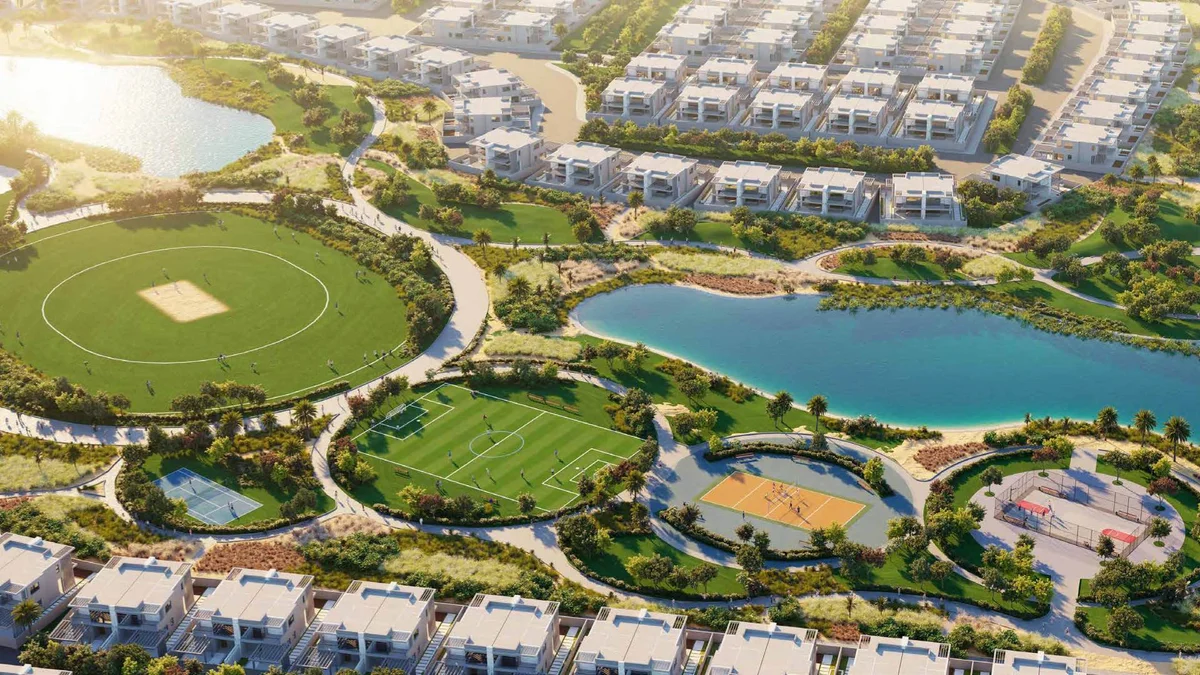
This community answers to two names, and that is the first thing a buyer needs to know because it quietly distorts every piece of research done about it. Akoya Oxygen was renamed DAMAC Hills 2. Both names are still in use, both draw roughly 12,100 searches a month, and anyone researching under only one of them is looking at half the picture.
Two names, and a third that is a different place
Three labels circulate and only two of them refer to this community.
DAMAC Hills 2 is the current name. Akoya Oxygen is the former name, still carried by listings, maps and a large share of search traffic. They are the same development, and the demand data counts them separately at roughly 12,100 monthly searches each, which is one audience split across two labels rather than two audiences.
DAMAC Hills, without the 2, is a different community entirely. It is earlier, more central, built around a golf course, and at a different price level. It shares a developer and part of a name with this one and very little else.
The practical consequence is about evidence rather than terminology. A buyer pricing a villa here needs the transaction record for this community, and a search under one name returns part of it while a search that accidentally picks up DAMAC Hills returns comparables from a different market at a different price. We verify which of the three a listing or a comparable actually refers to before using it, because the naming alone has produced more mispriced comparisons in this community than any other factor. The earlier community is covered separately on the DAMAC Hills page, and the developer itself in the DAMAC Properties review.
What is the search demand telling you?
That the community has a substantial audience split across two labels, and a small purchase-intent tail.
| Query | Monthly searches | What the searcher wants |
|---|---|---|
| damac hills 2 | 12,100 | Rentals, community services, directions, delivery news |
| akoya oxygen | 12,100 | The same community under its former name |
| villas for sale in akoya oxygen | 30 | Purchase, unambiguous |
Note also what the purchase tail looks like next to the reach. About 30 unambiguous buying searches a month sit under roughly 24,100 across the two community names, a ratio near 800 to 1. That is the ordinary shape for a residential community with a settled population, and it says the same thing here as elsewhere in the outer belt: the traffic is people looking for somewhere to live. For a landlord that is the favourable reading, and for a seller it means a resale is priced correctly against comparables rather than marketed to a wide audience.
The purchase phrase survives under the old name rather than the new one, which is itself a useful signal: the buying audience formed while the community was called Akoya Oxygen and has partly kept the habit. For anyone writing or marketing about this community, covering both names is not optional, because half the audience uses each.
Looking for the right Gulf property?
Get a free shortlist matched to your budget and target market. No commitment.
What did April 2024 actually show?
It showed which parts of the Dubai market are exposed to a rainfall outlier, and this community was among them. Being specific about that is more useful than either ignoring it or overstating it.
Dubai’s normal pattern is 75 to 100mm of rain a year across 10 to 20 days. April 2024 delivered roughly 254mm in 24 hours. That storm flooded airport taxiways, closed Emirates Road and Al Ain Road, and left standing water in this community as well as in parts of Jumeirah Village Circle and Dubai South.
The damage pattern was consistent and it is what makes the event actionable rather than merely alarming. Ground-floor stock took the water. Upper-floor apartments rarely flooded internally. Basement car parks produced heavy losses, and third-party-only vehicle policies turned those into five-figure bills for individuals. Uninsured tenants met contents gaps of AED 50,000 to 200,000.
The response is unit selection and paperwork rather than avoidance.
- Check the elevation of the specific plot rather than the community’s average
- Ask for evidence of post-2020 drainage works, which is a different standard from what existed when the earlier phases were built
- Get the insurance wording right, including Mollak-aware cover, and do not rely on third-party-only vehicle cover in a community with basement or open parking exposure
- Treat a National Centre of Meteorology alert as a remote-work day rather than attempting a flooded arterial in the first 48 hours
Our underwriting treats Dubai rain risk as a unit-selection problem first and a citywide narrative second, and this community is a case where that distinction does real work: two plots a few streets apart can have materially different exposure. The full analysis is in Dubai flooding and rain risk.
What does the location cost?
It is a genuinely remote community, and that is the trade the price reflects.
DAMAC Hills 2 sits well out along the Al Ain corridor, further from the established employment centres than the Dubailand communities and considerably further than the yield belt. The commute to the Marina or DIFC is a long one, and Emirates Road and Al Ain Road are the arteries that carry it, which is why their closure during the 2024 storm mattered so much to residents here.
That distance is priced in, and it defines the tenant pool. The households this community serves are those for whom space matters more than commute, those working in the southern and western employment areas, and those whose budget places them here. It does not compete for the tenant choosing between Marina and Downtown.
What follows for an owner is that a rent assumption cannot be borrowed from a more central community at a similar unit size. The rent here reflects the location, and a model that applies mid-market central rents to outer-community stock overstates the income before any other error is made.
What does a purchase cost?
The transaction stack is the same across the emirate, and the illustration below uses AED 1,400,000 as a round figure rather than as a claim about current pricing.
| Cost line | Rate | On a AED 1,400,000 purchase |
|---|---|---|
| DLD transfer fee | 4% of price | AED 56,000 |
| Agency commission | 2% plus 5% VAT | AED 29,400 |
| Trustee office fee | Capped by DLD regulation | AED 4,200 |
| Developer no-objection certificate | AED 500 to 5,000 | AED 2,000 |
| Title deed issuance | AED 250 to 580 | Included in the trustee bundle |
| Total closing | 6% to 7% | about AED 91,600 |
With a mortgage, add registration at 0.25% of the loan, an arrangement fee near 1% and a valuation of AED 2,500 to 3,500, taking the all-in figure closer to 8%. On villa and townhouse stock, add the owner-arranged service contracts that do not transfer automatically. The itemisation is in the cost of buying property in Dubai.
What are the running costs on villa stock here?
The community charge is levied per square foot of plot rather than of built area, which is the detail that surprises buyers arriving from an apartment. Dubai villa community charges broadly run in the region of AED 1.20 to AED 2.50 per square foot, and because the chargeable area includes garden, driveway and setbacks, the annual figure scales with land rather than living space.
Beyond that, villa stock carries costs an apartment does not. Cooling is the owner’s arrangement rather than a building service. Landscaping and, where fitted, pool maintenance run on monthly contracts. Building insurance is worth carrying, and in this community the insurance conversation should include the flood exposure discussed above rather than treating cover as a formality.
None of those appear in a gross yield calculation and all of them appear in the bank account, which is why the net rather than the gross is the number that decides an outer-community purchase.
An insider tip on buying in a community still under delivery
Insider tip: in a community where phases are still completing, ask the developer for the delivery schedule of everything within sight of the plot before agreeing a price, and ask specifically what remains unbuilt rather than what is finished. Two things follow from the answer and neither shows up in a viewing. The first is the living conditions across the next few years, since a villa that backs onto an active site carries construction traffic, noise and dust for the duration, and that is reflected in what a tenant will pay while it lasts. The second is the drainage, because infrastructure in an outer community is delivered alongside the phases rather than in advance, and a plot adjoining an unbuilt section may sit next to unfinished ground works. Buyers who ask only about their own villa get a complete answer to the wrong question. The developer holds the phase schedule and will provide it, and a plot that survives that question is worth more than one bought without it.
Who rents in an outer villa community?
Two groups, and the split determines how long a tenancy runs and therefore what the hold actually returns.
Families taking villa or townhouse space form the core. What they are buying with their rent is square metres and a garden at a price that would not reach the same space anywhere closer in, and that trade is not available to them in the apartment belt at any rent. Because the alternative to this community is either much less space or much more money, the switching cost is real and tenancies run long.
Households working in the southern and western employment areas form the second group. For them the commute that prices the community down is not a penalty, because their workplace sits on the same side of the city. This group is stable for structural reasons and is routinely overlooked by analysis that measures every Dubai community by its distance from DIFC.
What both groups have in common is that they chose this location deliberately rather than settling for it, and deliberate choices produce renewals. For an owner, that supports a longer vacancy assumption than an apartment in the yield belt would justify, with fewer re-lettings across a five-year hold and a re-letting commission near 5% of annual rent avoided each time.
The qualification is the delivery pipeline. While phases are still completing, new stock arrives into the same tenant pool, and a villa competing against freshly handed-over product nearby will feel it at renewal. That is a timing effect rather than a structural one, and it is the reason the phase schedule sits so high in the checklist above.
How does resale work while a community is still building?
It works, with one asymmetry a seller should understand in advance.
While a developer is still selling new phases, a resale competes against new product with a payment plan attached. A buyer choosing between a completed villa that must be paid for at transfer and an unbuilt one payable in instalments is making a financing decision as much as a property decision, and the resale has to answer that with something the new phase cannot offer.
Usually it can. A completed villa is inspectable, its surroundings are visible, its community charge is known, and it can be occupied or let immediately rather than in two years. Where it also has a tenancy in place, it offers contracted income rather than a projection. Those are genuine advantages and they belong in the pricing rather than being left implicit.
The asymmetry closes as the build-out completes, which is worth knowing for anyone modelling an exit. A community that finishes delivering stops competing with its own developer, and the resale market from that point is priced against other resales rather than against a launch. Buyers holding through the remaining phases should factor that into when they intend to sell, and the phase schedule that answers the drainage question answers this one too.
What should a buyer check here?
Seven items, ordered by how much each can move the outcome.
- The plot elevation and its position relative to the local drainage, given the April 2024 pattern
- Evidence of post-2020 drainage works serving that part of the community
- The delivery schedule for every phase within sight of the plot
- The community charge on the specific plot, since it is levied on land rather than built area
- The insurance wording, including Mollak-aware cover and parking exposure
- The commute the location actually imposes, tested at peak rather than estimated
- The comparable set, confirmed to be this community under either of its names rather than DAMAC Hills
We verify the elevation and the phase schedule before the yield model, because both change what the asset is rather than merely what it is worth.
Who should look at DAMAC Hills 2, and who should not?
It suits a buyer who wants villa or townhouse space at a low entry price and accepts a long commute in exchange, and who will do the plot-level drainage and delivery diligence rather than buying on the community name. It suits a family whose working life does not depend on a daily run to the coastal employment centres. It suits an investor underwriting on net after outer-community costs, with a rent assumption drawn from this community rather than a more central one.
It is a poorer fit for a buyer who needs proximity to the Marina, DIFC or Downtown, since the distance is the community’s defining feature. It is a poorer fit for anyone unwilling to price the flood exposure properly, because the honest response to April 2024 is diligence and correct insurance rather than either dismissal or alarm. And it is a poorer fit for a buyer who wants a settled, fully delivered environment now, since the build-out is still running.
Where should a buyer start?
Field note on sequence.
- Establish that every comparable being used refers to this community under either name, and not to DAMAC Hills
- Check the plot elevation and drainage evidence before anything else on the shortlist
- Get the phase delivery schedule for the surroundings from the developer
- Get the community charge for the specific plot, since it is levied on land
- Drive the commute at peak rather than accepting a quoted off-peak time
- Set the insurance wording deliberately, including contents and vehicle exposure
- Model the net against capital committed at transfer, meaning price plus the 6% to 8% of entry costs
The yield method is in the Dubai rental yield guide, and the wider comparison across Dubai’s bands sits in the best areas to buy property in Dubai.
Frequently Asked Questions
Yes. Akoya Oxygen was renamed DAMAC Hills 2, and both names remain in active use, which is why listings, maps and search results still carry each of them. Both names attract roughly 12,100 monthly searches in the UAE, and treating them as two separate communities is the most common error made about this development. It matters practically as well as tidily: a buyer researching under one name sees only part of the available listings and part of the transaction record, so search both when pricing.
No, and this is the second confusion worth clearing. DAMAC Hills is the earlier and more central community, built around a golf course. DAMAC Hills 2, the former Akoya Oxygen, is a separate and considerably more remote development further out along the Al Ain corridor. They share a developer and part of a name and very little else, including price level and location, so transactions in one are not comparable evidence for the other.
The community saw standing water during the April 2024 storm, alongside parts of Jumeirah Village Circle and Dubai South. That event was an outlier of roughly 254mm in 24 hours against a normal annual total of 75 to 100mm spread over 10 to 20 days, and it closed Emirates Road and Al Ain Road. Ground-floor stock took the damage while upper floors rarely flooded internally. The practical response is diligence rather than avoidance: check elevation, ask for post-2020 drainage evidence, and get the insurance wording right.
It is an outer-community villa and townhouse play at a low entry price, and it should be underwritten on that basis. The case rests on the price point and on tenant demand for family-sized space, set against a genuinely remote position and a delivery pipeline that is still running. The checks that decide it are specific rather than general: the plot elevation and drainage, the service charge on the plot, what remains to be built nearby, and whether the rent assumption reflects the commute the location imposes.
Yes. The development sits in designated freehold territory, so a foreign national holds title outright rather than a lease, and no plot-level eligibility check of the kind used in Dubai's older mixed-status districts applies. The diligence here is about the specific plot and the surrounding delivery position rather than about whether the purchase is open to the buyer.
Get a Gulf property shortlist
Tell us your budget and target market. Independent research first; enquiries are matched with licensed local partners. We reply within one business day.