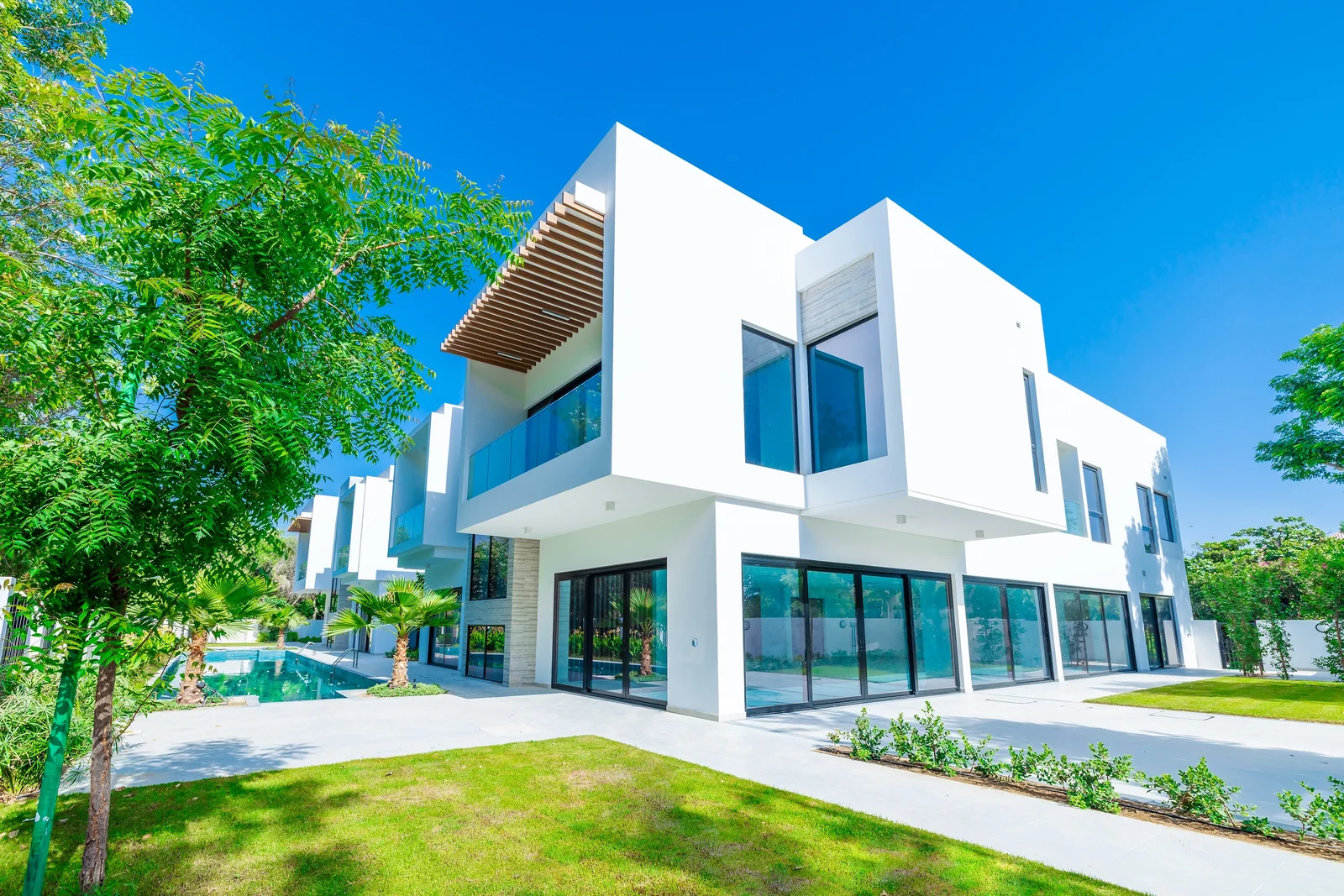
Every listing in Damac Hills sells three things: a villa, a community, and a name. The first two are yours on completion. The third is licensed, and the licence is an agreement between the developer and a brand owner that no purchaser signs, reads or votes on.
That is an ordinary commercial arrangement and it is not hidden. It is simply never presented as what it is from the buyer’s side, which is an exposure to a contract renewal that arrives without warning and shows up as a cost or a notice rather than as a decision.
One clarification before any of that, because it costs buyers real money. This page is about Damac Hills, the golf-course community. The separate development further out along the Al Ain corridor is DAMAC Hills 2, formerly Akoya Oxygen, and it sits at a different price level in a different location. The two share a developer and half a name, and comparable sales cross between them often enough to misprice both. Confirm which one a listing or a comparable refers to before using it.
What are you actually buying into?
Title to a home, plus a position downstream of a contract. The title is unambiguous and registered. The contract is neither, from where a buyer stands.
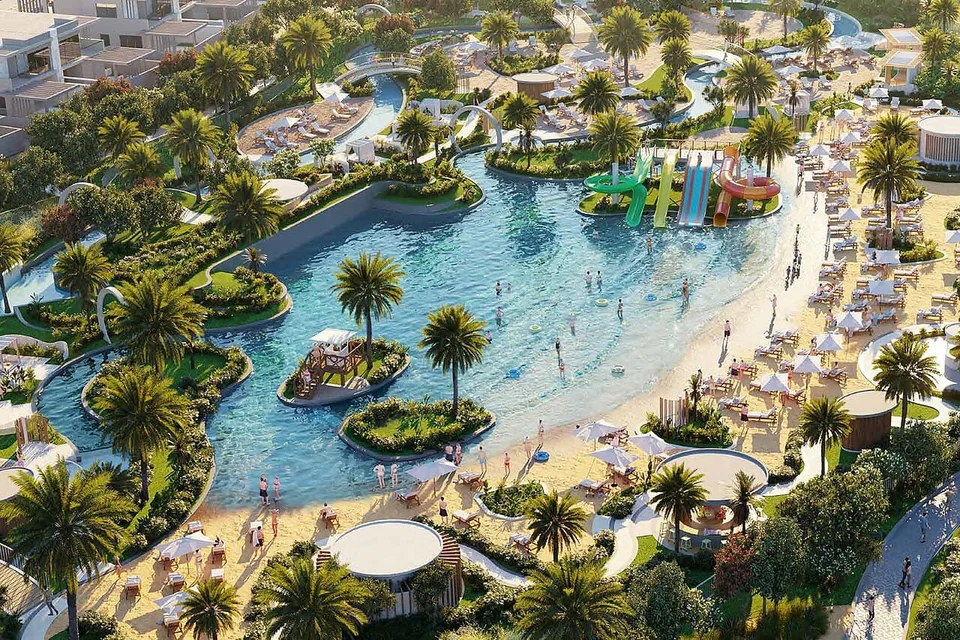
A licensed name is not decoration. It carries an agreed standard of operation, it sets what the amenity has to deliver, and it does real work in the resale market by placing the community in a category. Buyers price that category, agents market it, and valuers use it to build comparable sets. All of that rests on an agreement with a term and a renewal date, negotiated by two commercial parties with their own interests, neither of whom is obliged to consult the people whose largest asset sits inside the community the name describes.
Where does an owner sit in the structure?
An owner sits outside it, receiving the consequences. It is worth setting this out plainly, because the diagram is what makes the exposure obvious.
| Party | What they hold | What they decide |
|---|---|---|
| Brand owner | The name and the standard | Whether to license and on what terms |
| Developer | The licence and the master plan | Whether to renew and at what cost |
| Owners association | The community budget | Where a renegotiated cost lands |
| Individual owner | Title to one home | The purchase price, and nothing after it |
The bottom row is the whole argument. An owner’s only moment of influence over this is the moment before exchange, when the position can still be established and priced. After that the owner holds an asset whose category is decided elsewhere.
Buying in a branded Dubai community?
Send us the community and the unit. We will tell you which elements are licensed, what to ask the association, and how to price the renewal risk into your offer.
What are the three outcomes at renewal?
Quiet renewal, expensive renewal, or lapse. Each produces a different signal and only one of them is visible in advance.
Quiet renewal is the common case and it produces no signal at all, which is why the whole topic stays invisible for years at a time. Expensive renewal surfaces as money: a new or enlarged line in a community budget, an amenity fee that did not exist, or an access arrangement that changed. Lapse surfaces as a name change, and it is the outcome that produces the most noise and the least immediate practical effect. An owner watching for the second outcome is reading their association budget year on year and asking about any line that grows faster than inflation. That is the only early warning available, and it is available to anyone who reads. How Dubai budgets are structured and where to look sits on the service charges by area page.
What does de-branding actually change?
The comparable set, and almost nothing else. This distinction is the one most commentary gets wrong in both directions, either dismissing the risk entirely or treating a name change as a collapse.
Here is the mechanism. Property values move through comparison, so a valuer or an agent pricing your villa assembles recent sales of similar homes. If those sales were priced when the community carried a name it no longer carries, the comparison has to be rebuilt against a different set, and the rebuild takes time during which the market has no confident view of what your home is worth. That uncertainty is the cost, and it is temporary rather than permanent. Meanwhile the plot has not moved, the build has not changed, the school run is identical and the road network is the same. An owner who understands that they are exposed on the narrative rather than on the asset makes better decisions in both directions, because they neither panic nor pretend the exposure is zero.
How do you price this before you buy?
By asking five questions and treating the unanswered ones as the risk. What elements are licensed. Who the licensor is. How long the current term runs. What the association pays toward it now. What the community would be called without it.
A seller will know one or two. An association will know more. A developer’s sales office will know all of them and will not necessarily volunteer any. The value of asking is not confined to the answers you get, because the pattern of what nobody can tell you maps precisely onto the part of the purchase that is unpriced. A buyer who has run the five questions can make an offer with a stated allowance for the risk. A buyer who has not is making the same allowance implicitly, at zero, without having decided to. The wider off-plan and developer-risk framing sits on the off-plan property guide.
How does this compare with unbranded communities?
It swaps one uncertainty for another rather than adding one. Unbranded master communities carry their own version of the same structure, and it is worth saying so before the argument tips into scaremongering.
An unbranded community’s identity rests on the developer’s reputation, its own amenity standard and the quality of its association, all of which can also deteriorate and none of which an individual owner votes on either. What a licensed name adds is a defined standard with a counterparty who can enforce it, and a defined date on which the arrangement is reconsidered. That is a genuine benefit while it runs and a genuine discontinuity when it ends. The neighbouring family villa communities where the structure is different are on the Dubai Hills page, the Arabian Ranches page and the Tilal Al Ghaf page.
Who should buy in Damac Hills?
A buyer who wants the villa and the location, has priced the licence question, and is not relying on the brand to do the work of the exit.
That buyer does well here, because the underlying product is a large-plot family community with a serious amenity and a road position that will not change. The buyer who does badly is the one whose whole case is the premium the name commands, since that is the single component of the value that a contract they never saw can remove. Put differently: buy the community and treat the name as an unpriced option that may or may not still be attached when you sell. Everyone who has done that has a plan for both outcomes, and everyone who has not is holding one outcome and calling it certainty.
Frequently Asked Questions
It is a contract between the developer and the owner of a name, permitting that name to be used on a community, an amenity or a building to an agreed standard. Buyers are not parties to it. Where a community's identity, its headline amenity and part of its resale positioning rest on that licence, an owner holds a title whose market presentation depends on an agreement they cannot read, cannot vote on and are not told the term of.
The developer and the brand negotiate, and one of three things follows. It renews on similar terms and nothing visible changes. It renews on different economics, and the new cost appears somewhere, most often as a service charge line or an amenity fee. Or it does not renew, and the community is rebranded or de-branded. Owners learn which one happened afterwards, as a fee or a notice.
It would change what the property is compared against, which is the mechanism that matters. Values move through comparables, and if every comparable sale used to price your villa carried a brand your villa no longer carries, the comparison set has to be rebuilt. The land, the build and the location are unchanged. What changed is the story the market prices, and stories are a real component of a resale premium rather than a fictional one.
Not directly, and pretending otherwise is unhelpful. The contract is between two parties and an individual owner is neither of them. What an owner can do is establish the position before buying, price the risk into the offer, and watch the association budget for the line where a renegotiated licence would surface. Information and pricing are the available levers; a vote is not one of them.
Ask what the licensed elements are, who the licensor is, how long the current term runs, what the association pays toward it today, and what the community would be called if it lapsed. A seller will rarely know all five and the association will know more. The value of asking is not only the answers: a question nobody can answer identifies exactly where the unpriced risk sits.
Not at all, and that is the reason it goes unnoticed. Licensed names attach to amenities, hotels, residences and whole communities across Dubai, and the structure is the same in each case: a contract between a developer and a brand, with owners downstream of it. Damac Hills is a clear worked example because the licensed element is prominent enough that its absence would be noticed.
Almost none of it. The villa, the plot, the road network, the school run and the neighbours are what they are regardless of whose name is on the golf course. That is the honest half of the argument and it is why this is a pricing question rather than a warning. What is exposed to the licence is the resale narrative and possibly a cost line, not the experience of living there.
What is the search demand telling you about Damac Hills?
Damac Hills draws about 340 property searches a month, led by damac hills villas for sale at 210, and returns no impressions in our own Search Console data. The investment phrasing measured zero.
The demand is villa-led by roughly two to one, which is consistent with what the community actually is and inconsistent with how it is usually written about. Most content on branded communities leads with the amenity and the name. The people searching lead with the product.
That gap is the same one this page argues about the brand licence, seen from a different angle. A buyer searching for a villa is buying a house on a plot in a specific location, and every one of those attributes is unaffected by whose name sits on the golf course. What the licence touches is the comparable set the resale is priced against and a cost line the owner does not control, and neither of those is visible in a search query or in a listing.
Two practical consequences follow for a buyer here, and they run in opposite directions.
The first is reassuring. Because the villa itself is unaffected by the licence, the ordinary villa diligence still governs the purchase: the plot, the layout, the condition of the cooling plant and the roof, the approval status of any extension, and the community charge levied on plot area rather than built area. A buyer who does that work well has protected the large majority of the value regardless of what happens at a renewal they will never see.
The second is not. Because the licence touches the comparable set, it touches the exit rather than the entry, and exits are where owners have the least flexibility. A buyer who has priced the licence position into the offer has bought optionality. A buyer who has not has bought the same house at a price that assumed a category the community might not always occupy. The difference between the two costs nothing to establish before exchange and cannot be recovered afterwards.
Where should a Damac Hills buyer start?
Field note on sequence, combining the ordinary villa diligence with the one question this page exists to raise.
Establish the plot size and the villa type first, since they set both the comparable set and the community charge levied on plot area. Pull transactions for that type rather than for the community. Commission a survey covering the systems rather than the finishes. Confirm the approval status of any extension. Then, separately, establish the licensed elements, who the licensor is, how long the current term runs, what the association pays toward it today, and what the community would be called if it lapsed.
The first five questions protect the large majority of the value and are answered by documents. The last five protect the exit and are answered, if at all, by the association rather than by the seller. A question nobody can answer is not a dead end. It identifies exactly where the unpriced risk sits, which is the most useful thing a buyer can learn before making an offer.
Get a Gulf property shortlist
Tell us your budget and target market. Independent research first; enquiries are matched with licensed local partners. We reply within one business day.