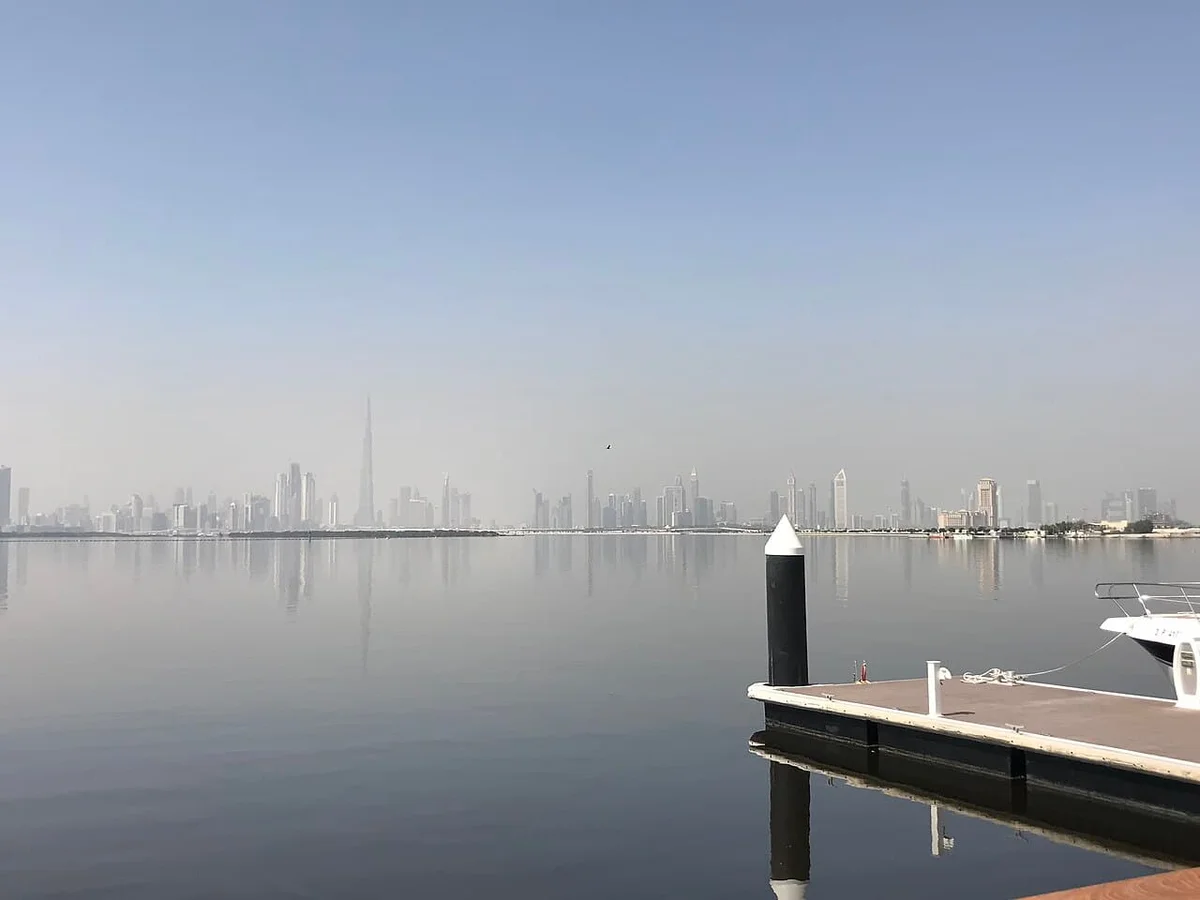
Marina property is sold as one product. It is two, and only one of them appears on a title deed.
The apartment is a registered freehold interest with a service charge, an association and a set of obligations that behave like any other Dubai residential asset. A berth is an agreement with the marina operator, on their terms, at their rate, with its own renewal and its own transfer rules. Different counterparty, different document, different risk.
What conveys with the title, and what does not?
The apartment does. The water does not, unless a specific document says something specific about it for this specific unit.

This sounds obvious written down and it is routinely lost in practice, because everything about how marina property is presented encourages the merger. The photography puts the boats and the balcony in one frame. The listing describes a lifestyle in which the two are continuous. The name of the development is the name of the marina. None of that is misleading in itself, and the cumulative effect is that a buyer forms an impression of a single asset and then transacts on a document that describes one of its halves. The correction is not scepticism about the district. It is asking, for the unit in front of you, what the paperwork actually says about the water.
What are the two agreements, side by side?
Different in every respect that matters to an owner. Setting them out together is the fastest way to see why they cannot share a line in a model.
| The apartment | The berth | |
|---|---|---|
| What you hold | Registered freehold title | A contract with the operator |
| Counterparty | Owners association and managing agent | Marina operator |
| Running cost | Service charge, budgeted and adopted | Berth fee, set by the operator |
| How the cost changes | Association budget cycle | The operator’s own schedule |
| Renewal | Continues with ownership | Governed by the agreement’s term |
| On sale | Transfers with title | Depends on the agreement |
The bottom two rows are where purchases go wrong. An owner who has assumed the water side behaves like the property side has assumed continuity where a term exists and transferability where consent is required, and both assumptions are only tested at the point of sale or renewal.
Buying at Dubai Harbour with a berth in the picture?
Send us the unit. We will tell you what to request on the marina agreement, its term and its transfer position before you exchange.
Why does it matter to a landlord with no boat?
Because your tenant’s expectation is formed by the same marketing yours was. This is the practical version of the argument and it applies to owners who will never set foot on the water.
A tenant taking a marina apartment at a marina price has, in their own mind, taken a marina apartment. If access to the water turns out to be a separate arrangement they have to make themselves, at a cost nobody mentioned, the shortfall lands in the tenancy: in the negotiation, in the first renewal, or in a decision not to renew at all. A landlord who knows precisely what the letting includes can market it accurately, price it accordingly and avoid the retention problem entirely. One who lets an ambiguity stand has taken on an expectation gap that will be resolved at their expense, and it will be resolved during the months they were counting on the income.
How should the yield model be built?
As two items or one, never as a blend. The apartment produces a rent against a service charge, and that computation is complete on its own.

Where a berth genuinely attaches and can be sub-let or included, it is a second item with its own revenue, its own fee and its own risk of the operator changing terms, and it belongs in the model as a separate line that can be switched off to see what remains. Where it does not attach, the honest yield is simply the apartment’s, and the marina is an amenity that supports the rent in the same way a beach or a park does. Both of those are respectable models. The one that is not respectable is the single blended figure that quietly assumes the water conveys, because it produces a number nobody can reconstruct and it will be quoted onward by people who never saw the assumption.
What does this do at exit?
It decides what you can honestly represent. A seller with a berth agreement, its term and its transfer position documented is selling a package a buyer can underwrite.
A seller who can only point at the marina is selling an apartment beside water, which is a genuinely attractive proposition and is not the same proposition. Buyers with competent advisers find the difference during diligence, and they find it after the price was agreed on the first impression, which is the most expensive point in the process to discover anything. Assembling the water-side paperwork at purchase rather than at sale removes that entirely, and it costs nothing at the time because the documents are being handed over anyway. The neighbouring waterfront districts, where the same product-versus-title question takes different forms, are on the JBR page, the Dubai Marina page, the Bluewaters page and the Palm Jumeirah page.
Who should buy at Dubai Harbour?
A buyer who wants the position and has established what they are buying on the water, including the answer that they are buying nothing there.
That last case is common and it is fine. The district’s fundamentals do not depend on a mooring: beach access, a cruise terminal bringing genuine footfall, an outlook over an active marina and a location wedged between two of Dubai’s most established waterfront addresses. A buyer purchasing that, at a price that reflects that, has bought well. The buyer who has trouble is the one who paid a marina premium for an apartment and holds no document connecting the two, and who will meet that gap twice: once when a tenant asks, and once when a buyer’s lawyer does. The other end of the same creek-to-coast waterfront market is on the Creek Harbour page.
Frequently Asked Questions
Not as a matter of course, and this is the assumption to test rather than inherit. A mooring is typically an agreement with the marina operator, on the operator's terms and at the operator's rate, and it is a separate arrangement from the title to the apartment. Whether any particular unit carries a berth, on what basis and for how long, is a question about that unit's paperwork rather than about the development.
Because the tenant might, and because the marketing that supports the rent is built on the marina. If the product a tenant thinks they are renting includes water access, and the landlord is only letting the apartment, there is a gap between the offer and the expectation that shows up in negotiation, in retention and in what the unit actually achieves. A landlord who understands the split can price and market it deliberately.
That is governed by the agreement rather than by the sale, so the answer is in the document and not in the listing. Some arrangements transfer, some require the operator's consent, some end on a change of ownership. A seller describing a berth as part of the property is describing an expectation, and the buyer's job is to find out which of those three cases they are actually in, in writing, before exchange.
By modelling the apartment alone and treating anything on the water as separate. Two contracts with two counterparties, two cost bases and two renewal mechanisms do not belong in one line. Where a berth genuinely conveys and generates income, model it as its own item with its own cost and its own risk; where it does not, the honest yield is the one the apartment produces without it.
They belong to the marina agreement and follow its own schedule, which is set by the operator rather than by an owners association. That means the mechanism that governs it, the notice you receive and the recourse available if it changes are all different from the ones that govern your service charge. It is not more or less expensive as a rule; it is governed differently, and the difference is what needs establishing.
It affects what you are able to represent. A seller who can produce a berth agreement, its term and its transfer position is selling a documented package. One who can only say the building has a marina is selling an apartment next to water, which is a genuinely good thing and a different thing. The gap between those two positions is discovered by buyers at exactly the moment it is most expensive to discover.
Frequently yes, and it is important to say so rather than let the analysis read as a warning. The location has beach access, a cruise terminal, a marina outlook and a position between two established waterfront districts, and none of that requires an owner to have anything on the water. The purchase that goes wrong is not the one without a berth. It is the one that paid for a berth it does not have.
What is the search demand telling you about Dubai Harbour?
The name draws roughly 40,500 searches a month, and our measured transactional demand for the district is zero on every phrase. When we ran the search results for the bare name through our collector it returned nothing usable, so unlike Dubai Islands we cannot characterise what those searchers are shown, and saying so is more useful than guessing.
What we can say is where the demand in this district actually lives. Emaar Beachfront, which sits inside Dubai Harbour, draws about 12,100 searches a month on its own name and was confirmed as a genuine property result. The district is the container; the development inside it is what people search and buy.
That pattern recurs across this corpus and it is worth recognising rather than fighting. Umbrella names collect very little demand of their own, because buyers search for the thing they can actually purchase. MBR City behaves the same way, drawing 40 a month while Sobha Hartland, District One and Meydan carry their own audiences underneath it.
How should this page be used?
As an orientation layer rather than as a pricing source, which is the honest job of a district page sitting above a development that carries the demand.
Establish first which development inside Dubai Harbour a property actually sits in, because that determines the comparable set, the service charge, the developer and the delivery position. Two apartments both described as Dubai Harbour can differ in all four. Where the answer is Emaar Beachfront, the analysis that matters sits on the Emaar Beachfront page, including the short-let question that decides what an owner there actually earns.
Then apply the checks that waterfront stock always needs and that scarce public evidence makes more important. The service charge per square foot for the specific tower, in writing from the owners association, since premium buildings carry more amenity, more facade and more plant, and coastal exposure raises the cost of maintaining all of it. The reserve fund position, because a seafront building will certainly need envelope work and the only question is whether it arrives as a budgeted item or as an assessment. The floor, the aspect and what is genuinely visible, since on waterfront stock the view is a large share of the price and cannot be refurbished into existence. And the delivery position of surrounding phases, which affects both the outlook and the letting market while construction runs.
The test for whether the research has been done properly is simple. If a figure cannot be traced to a named development, a specific building and a dated transaction, it is not evidence about anything a buyer can purchase here.
Who rents on the waterfront here, and what does that mean?
Three groups, and which one a unit serves changes both the rent and the cost of achieving it.
Short-stay visitors are the group a marina and beach position attracts most distinctively. They pay the highest nightly equivalent and cost the most to serve through management, cleaning, furnishing wear and the vacancy between stays, and their demand is seasonal, so an annual model built on peak occupancy overstates the year.
Professional households on annual tenancies are the steadier half. They cost far less to serve, their rent is fixed for the term, and they suit an owner who does not want an operating business attached to an apartment.
Owner-occupiers and part-year residents form the third group and set the resale market rather than the rental one, since a large share of premium waterfront demand is people buying to use rather than to let.
The consequence for underwriting is the same one the Emaar Beachfront page makes at length: the vacancy and cost assumptions have to follow the group rather than the address, and a model that takes short-let nightly rates and applies annual-tenancy costs to them describes a business nobody operates.
The practical sequence is therefore to establish the development, then the building, then the operating model, and only then the price, because each of the first three changes what the fourth should be.
Working in that order costs nothing and prevents the most common error here, which is pricing a district rather than a building.
Get a Gulf property shortlist
Tell us your budget and target market. Independent research first; enquiries are matched with licensed local partners. We reply within one business day.