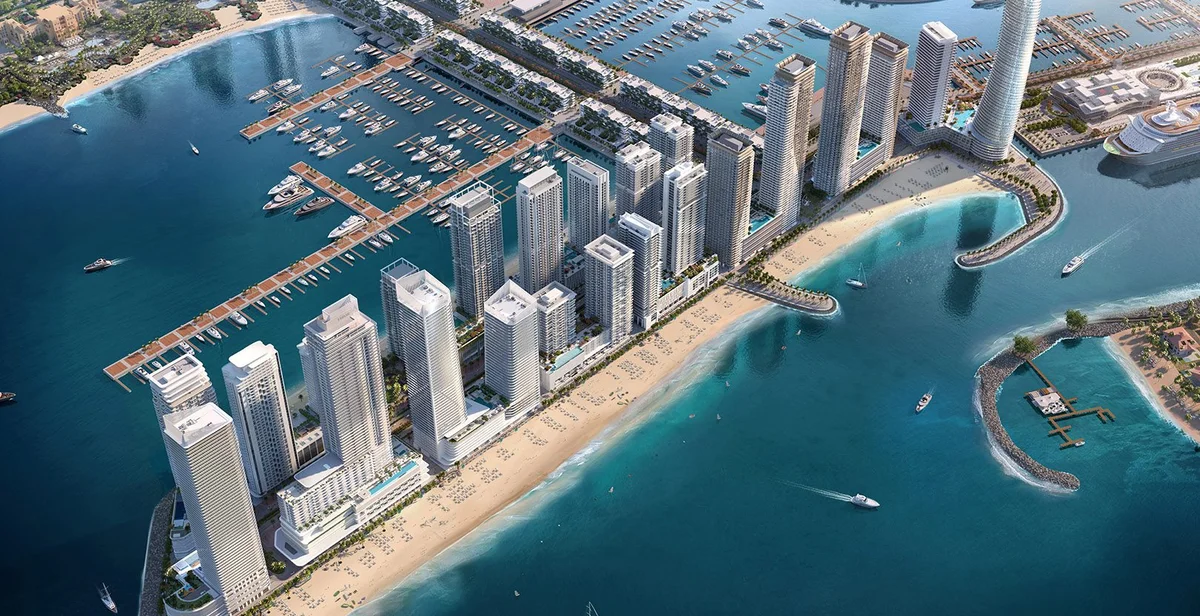
Emaar Beachfront is priced as a waterfront address and yields like one. The corpus position on it is three words long and worth taking literally: premium pricing, tourism-adjacent tenancy, moderate yield. Those are not three separate observations. They are one fact stated three ways, and understanding the link between them is the whole of the analysis.
Why do those three characteristics travel together?
Because the frontage causes all of them.
The beach position sets the price, since waterfront supply in Dubai is finite and the premium over an inland apartment of the same size is the market pricing that scarcity. The same position sets the tenant, because a location visitors want attracts short-stay demand alongside residents. And the combination sets the yield: the price rises faster than the achievable long-let rent does, so the gross figure lands in the moderate band even though both the price and the rent are high in absolute terms.
That is not a flaw in the asset. It is what a premium address does, and the same pattern appears on Palm Jumeirah and along the Marina waterfront. What it means practically is that anyone underwriting Emaar Beachfront against a mid-market yield expectation is applying the wrong benchmark, and anyone quoting a high yield here is almost certainly quoting a short-let gross figure without the costs attached.
Can a foreign buyer own here?
Yes, outright. The development is in designated freehold territory, so title is issued in the buyer’s name with no lease term and no plot-level eligibility check of the kind that applies in Dubai’s older districts.
- Title is freehold and recorded in the Dubai Land Department register
- Ownership carries no residency requirement, and residency does not follow from ownership
- The purchase can be registered jointly or through a corporate structure, with the arrangement recorded on the deed
The designated list and the wider rules are in the Dubai freehold areas list. Here they settle the question rather than complicating it, which puts the analysis onto the tower and the operating model.
What does the short-let question decide?
More than any other single choice a buyer makes here, and it has to be settled before the purchase rather than after.
A unit operated as a short let and the same unit operated on an annual tenancy are different businesses. The short let carries furnishing, a management fee, higher utility and cleaning costs, licensing obligations, and an occupancy rate that varies by season. The annual tenancy carries a letting commission, a void between tenants, and a rent fixed for the term. Their gross figures are not comparable and their net figures often converge much more than the headline numbers suggest.
Three things follow for a buyer.
The building’s own policy comes first. Not every tower permits short-let operation, and a purchase premised on it in a building that does not allow it is a purchase premised on nothing. Establish the position from the owners association in writing rather than from an agent.
The unit has to suit the model. Configuration, furnishing standard and aspect matter more for short lets than for annual tenancies, and retrofitting after purchase is a cost that belongs in the entry budget.
The costs have to be modelled honestly. A short-let gross yield with no management fee, no furnishing amortisation, no seasonal vacancy and no licensing cost is a marketing number. The method for building a defensible figure is in the Dubai rental yield guide.
Looking for the right Gulf property?
Get a free shortlist matched to your budget and target market. No commitment.
How does it compare with the other waterfront addresses?
The comparison set is small and each option is a different proposition rather than a cheaper or dearer version of the same thing.
| Address | What it is | What distinguishes it |
|---|---|---|
| Emaar Beachfront | Newer towers at Dubai Harbour with beach frontage | Emaar stock, tight footprint, marina and beach together |
| Palm Jumeirah | Established waterfront across a large master plan | Deepest waterfront resale record, widest range of products |
| Dubai Marina | Dense high-rise marina district | Larger rental market, lower price per square foot |
| Bluewaters Island | Compact island development | Retail and leisure anchored, distinct island position |
Against Palm Jumeirah, Emaar Beachfront trades scale and transaction depth for newer stock in a tighter setting. Against Dubai Marina it trades price and rental market size for frontage and specification. Against Bluewaters it is a different kind of waterfront again, more residential in emphasis.
One more distinction runs underneath the table and is easy to miss. Palm Jumeirah and Dubai Marina both had years in which their supply arrived, their tenant markets settled and their transaction records accumulated, and a buyer there is pricing against a long series of comparable sales. Emaar Beachfront is newer, with a shorter record and a smaller number of completed transactions to price against, which makes the individual tower and the individual unit carry more of the valuation weight. That is neither an advantage nor a drawback in itself, but it changes the method: a buyer here should expect to work from fewer, closer comparables and to lean harder on the specific characteristics of the apartment.
The practical use of the table is that these four should not be compared on yield alone. They differ in tenant profile, in the depth of their resale pools and in how much of the price is the position rather than the building, and a comparison that reduces them to a single percentage discards exactly the information that separates them. The wider context on Dubai Harbour as a district sits on the Dubai Harbour page, and Emaar as a developer is assessed in the Emaar Properties review.
What does a purchase cost?
The transaction stack is the same across the emirate. The figures below use AED 3,000,000 as a round illustration rather than as a claim about current pricing, which should be taken from recent transactions in the specific tower.
| Cost line | Rate | On a AED 3,000,000 purchase |
|---|---|---|
| DLD transfer fee | 4% of price | AED 120,000 |
| Agency commission | 2% plus 5% VAT | AED 63,000 |
| Trustee office fee | Capped by DLD regulation | AED 4,200 |
| Developer no-objection certificate | AED 500 to 5,000 | AED 3,000 |
| Title deed issuance | AED 250 to 580 | Included in the trustee bundle |
| Total closing | about 6% | about AED 190,000 |
With a mortgage, add registration at 0.25% of the loan, an arrangement fee near 1% and a valuation of AED 2,500 to 3,500, taking the all-in figure closer to 8%. On a short-let strategy, add furnishing to that entry budget, since the unit cannot trade without it. The itemisation is in the cost of buying property in Dubai.
What do the running costs look like on waterfront stock?
Higher than the mid-market, and this is the line most often left out of a waterfront yield calculation.
The service charge is levied per square foot of built area, and premium buildings carry more of everything that a charge pays for: amenity provision, facade area, lift and plant capacity, security and concierge. Coastal exposure adds to the maintenance burden on the building envelope, which is a real cost rather than a theoretical one on a seafront tower.
Cooling is billed through the building or a district provider, and on a large apartment it is a meaningful annual figure. Contents and building insurance is standard at this value. Where the unit runs as a short let, add management, cleaning, linen, utilities during vacancy and platform commission.
The number that matters is the charge per square foot for the specific tower, obtained in writing from the owners association, together with the reserve fund position. On a premium purchase the charge is large enough in absolute terms that a difference between two towers can outweigh a difference in asking price, and the reserve fund determines whether the next major maintenance cycle arrives as a planned expense or as a special assessment.
An insider tip on buying a waterfront apartment
Insider tip: before agreeing a price on any Dubai waterfront apartment, get three documents rather than one. The service charge per square foot for the specific tower, the reserve fund position, and the building’s written short-let policy. Each one can move the outcome more than the negotiation will. The charge determines the net, and on premium stock it is large enough that the cheaper of two apartments can be the more expensive to hold. The reserve fund determines whether the facade and plant maintenance that a seafront building will certainly need arrives as a budgeted item or as a bill to the owner of the day. And the short-let policy determines whether the operating model the purchase was underwritten on is permitted at all, which is a binary that no amount of price negotiation can fix afterwards. All three are available on request from the owners association, none appears in a listing, and a seller who is reluctant to produce them has told you something useful.
Who rents on the waterfront, and what does that mean for a hold?
Three groups, and which one a specific unit serves determines both the rent and the cost of achieving it.
Short-stay visitors are the group the location attracts most distinctively, and they are the reason the corpus describes the tenancy here as tourism-adjacent. They pay the highest nightly equivalent and cost the most to serve, through management, cleaning, furnishing wear and the vacancy between stays. Their demand is seasonal, which means an annual model built on peak-season occupancy overstates the year.
Corporate and relocating professionals form the second group and take conventional annual tenancies. They are the steadier half of the market, they cost far less to serve, and their rent is fixed for the term. For an owner who does not want an operating business attached to the apartment, this is the group the purchase should be underwritten on.
Owner-occupiers and part-year residents form the third, and they matter even though they pay no rent, because they set the resale market. A large share of demand for premium waterfront stock is people buying to use it, and that keeps the resale pool wider than the rental yield alone would suggest.
The consequence is that the vacancy and cost assumptions have to follow the group, not the address. A model that takes short-let nightly rates and applies annual-tenancy costs to them produces a number that no operator has ever achieved.
How does resale work here?
On the strength of the specific unit rather than the development, and the variables are narrower than in a mixed district.
Floor, aspect and what is genuinely visible from the windows carry a large share of the price on waterfront stock. Two apartments of identical size in the same tower can differ substantially on view alone, and that difference is durable because it cannot be changed by refurbishment. Pricing a resale against a per square foot average for the development ignores the one variable that buyers here care about most.
The delivery position of surrounding phases is the second variable, and it cuts both ways across a hold. Active construction nearby affects outlook and letting while it runs, and its completion can either open or close a view permanently. A buyer should establish what is approved on the adjacent plots rather than assuming the current outlook is the permanent one, and a seller should expect an informed buyer to ask.
The buyer pool for a resale is wider than the rental market implies, for the reason given above: owner-occupiers and part-year residents buy premium waterfront stock to use rather than to let. That group is less sensitive to yield arithmetic and more sensitive to the specific apartment, which rewards presentation and condition more than it does in the yield belt.
What should a buyer check here?
Seven items, weighted toward the building and the operating model.
- The service charge per square foot for the tower, in writing from the owners association
- The reserve fund position, given the maintenance burden a seafront building carries
- The building’s short-let policy, if the purchase is underwritten on that model
- The floor, aspect and what is actually visible from the unit, since on waterfront stock the view is a large share of the price
- The delivery position of surrounding phases, because construction next door affects both the outlook and the letting market while it runs
- The unit’s furnishing and configuration against the intended operating model
- The current tenancy where one exists, including its remaining term, since it transfers with the property
We verify the charge and the short-let policy before the yield model, because those two inputs decide whether the model is describing the actual asset.
Who should look at Emaar Beachfront, and who should not?
It suits a buyer who wants beach frontage with newer stock and a developer with a documented delivery record, and who values the position for its own sake rather than as a yield input. It suits an owner-occupier or a part-year resident, which is a large share of the demand for this kind of address. It suits an investor who has decided on an operating model in advance and priced it honestly.
It is a poorer fit for a buyer chasing the highest gross yield in Dubai, which is found in the mid-market apartment belt rather than on the waterfront. It is a poorer fit for a buyer who wants the deepest possible resale record, which Palm Jumeirah holds. And it is a poorer fit for anyone underwriting on a short-let gross figure without confirming that the building permits short lets and without pricing the costs that model carries.
Where should a buyer start?
Field note on sequence.
- Decide the operating model first, short let or annual tenancy, because it governs the unit, the furnishing budget and the cost base
- Confirm the building’s short-let policy in writing if that is the model
- Get the service charge per square foot and the reserve fund position from the owners association
- Price the specific tower against recent transactions in that tower rather than against a waterfront average
- Check the delivery position of the surrounding phases, since active construction affects both outlook and letting
- Model the net against capital committed at transfer, meaning price plus roughly 6% to 8% of costs, plus furnishing where the model requires it
The wider framework for choosing between Dubai addresses sits in the best areas to buy property in Dubai.
Frequently Asked Questions
It is a waterfront asset bought for the position and the developer rather than for the yield table. The combination the corpus records is premium pricing, tourism-adjacent tenancy and moderate yield, and all three follow from the same fact: the beach frontage that sets the price also sets the tenant. An investor comparing it against a mid-market apartment on gross yield will find it behind. An investor comparing it on tenant quality, rent resilience and the depth of the resale market for beachfront stock is comparing the things it is actually strong at.
It means a meaningful share of the demand for these apartments is short-stay or seasonal rather than a conventional twelve-month tenancy, because the location is one visitors want. That has two consequences. Gross figures quoted on a short-let basis are not comparable with a long-let yield, since they carry management fees, furnishing, higher turnover costs and a variable occupancy. And the operating model has to be decided before purchase, because a unit configured and furnished for short lets is a different product from the same unit let annually.
Emaar Beachfront sits at Dubai Harbour and connects marina living with the Emaar brand, which places it between the two rather than in competition with either. Palm Jumeirah is a larger, more established waterfront address with a deeper and more varied resale record. Dubai Marina is denser, cheaper per square foot and carries a much larger rental market. Emaar Beachfront is newer stock in a tighter footprint, and the case for it rests on that newness and on the frontage rather than on either scale or price.
Yes. The development sits in designated freehold territory, so a foreign national holds title outright rather than a lease, and there is no plot-level eligibility question of the kind that applies in Dubai's older mixed-status districts. The checks that matter here are about the specific tower and unit: the service charge, the floor and aspect, the building's short-let policy, and the delivery position of the surrounding phases.
Higher than in the mid-market, and that is the single most common omission in a waterfront yield calculation. Premium buildings carry more amenity, more facade to maintain and more plant, and coastal exposure raises the cost of maintaining all of it. The charge is levied per square foot of built area and should be obtained in writing from the owners association for the specific tower rather than estimated from a district figure, because on a premium purchase it is large enough in absolute terms to move the net materially.
Get a Gulf property shortlist
Tell us your budget and target market. Independent research first; enquiries are matched with licensed local partners. We reply within one business day.