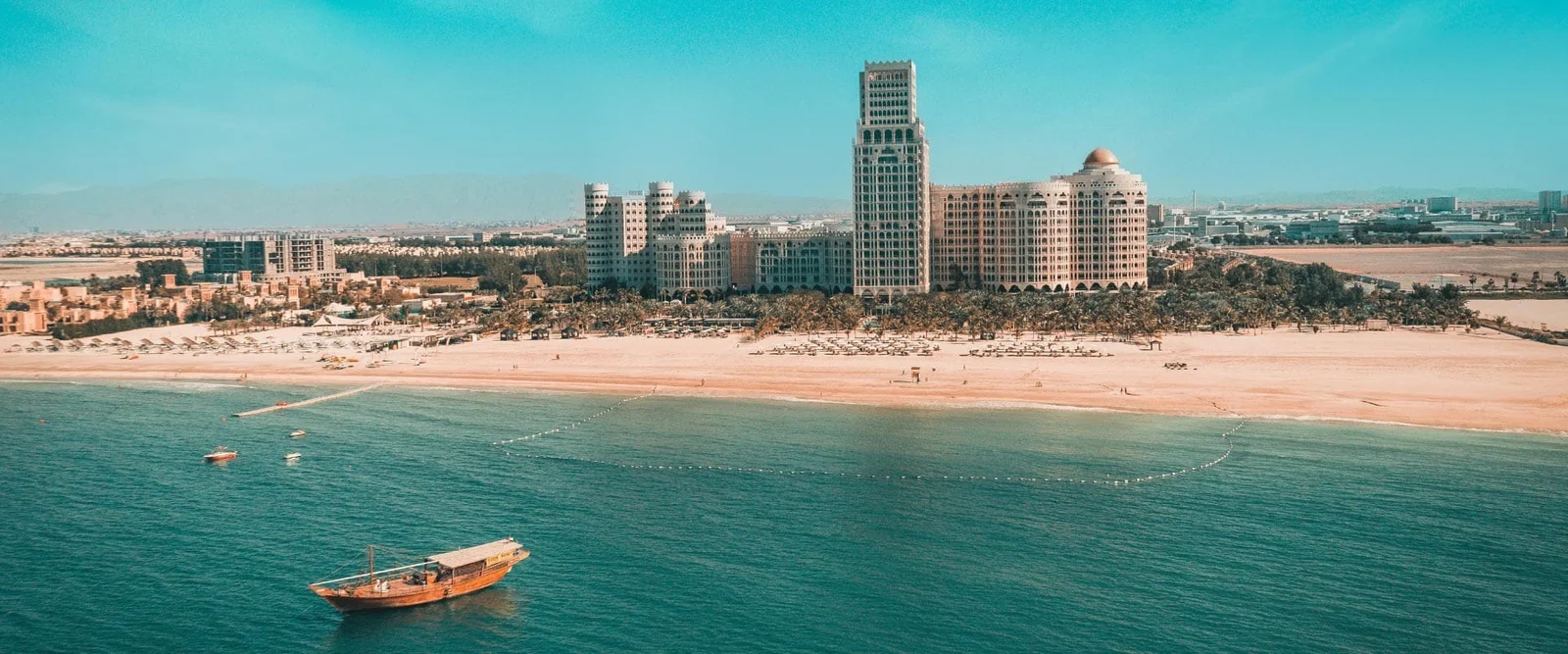
Every service charge answers a small question: what does it cost to run this community for a year. Very few of them answer the large one, which is who pays when something big wears out.
On a community past its first decade that question stops being theoretical. Facades, chillers, lifts, roofs, pools and, on a resort, the water itself all have lifespans, and they arrive at the end of them regardless of what anyone budgeted. What decides whether that is a manageable event or an unbudgeted demand is whether money was set aside for it in advance.
What does a reserve fund actually do?
It converts a large irregular cost into a small regular one. That is its entire function, and it is the difference between a predictable ownership cost and an unpredictable one.
The arithmetic is not complicated. A major item has a known service life and a known replacement cost, so the annual amount needed to have the money ready is a division. What makes it hard is not the sum but the incentives: contributing to a reserve raises this year’s charge for a benefit that lands after most current owners have sold, and reducing it lowers the charge for everyone present today. Communities that fund reserves properly do so because somebody insisted early, when the pressure not to was strongest and nothing was visibly failing. Communities that did not are usually not badly run in any other respect. They simply took the option that was easier every single year until the year it was not.
Why does this bite harder on a resort community?
It has more of these assets, and worse ones. A conventional residential building has a defined set of expensive components. A resort community has all of those plus a category that does not exist elsewhere.
| Asset type | Where it exists | Renewal cost profile |
|---|---|---|
| Lifts, roofs, facades | Any building | Large, periodic, predictable |
| Chillers and plant | Any serviced building | Large, periodic, predictable |
| Waterways and shorelines | Resort communities | Recurring, weather-driven, hard to schedule |
| Marina and leisure structures | Resort communities | Exposed to salt and constant use |
| Extensive landscaping | Resort communities | Continuous, and expensive to restore once lost |
The bottom three rows are the reason this page exists as a resort community page rather than a general one. They are large, they are exposed to an environment that degrades them faster than an inland building degrades, and their timing is less predictable than a lift replacement. A reserve position that would be adequate for a standard tower is not adequate here.
Buying in an established resort community?
Send us the community and the unit. We will tell you what to request on the reserve position and how the last major works were funded.
What are the three questions?
The reserve study, the current balance, and the funding history of the last two major works. Together they take a morning to ask and they tell you more about your future cost than any yield table.
The third one carries most of the information, because it is the only one that describes behaviour rather than intention. A community that paid for its last significant job out of a held reserve has demonstrated the system works. One that raised a special levy has demonstrated the system does not, which is useful and survivable knowledge if you have it before buying. One that has done neither in a community old enough to have needed something is the answer that should slow a purchase down, because it means the work has been deferred rather than funded, and deferral is not a saving. It is a cost accruing to whoever is present when it stops being deferrable.
What does a levy do to an investor specifically?
It lands on the return, in a year you did not choose, in an amount you did not set. That is a different kind of exposure from a service charge and it deserves to be modelled differently.
A service charge is a known deduction that a rent covers. A levy is a capital call that arrives whether or not the unit is let, is not recoverable from a tenant, and does not care what your year looked like. For a landlord holding on a thin net margin, a single levy can consume more than a year of the return, which means it is not really a cost item at all but a solvency question. And it does its worst damage at sale: a levy under discussion is a disclosed liability, and buyers price an uncertain future demand more harshly than a known one, so the seller pays for it twice. Every one of these effects is avoidable by asking three questions before exchange.
How should this change what you compare?
By replacing the annual rate with the rate plus the reserve position. Two communities quoting similar charges can be in entirely different financial states, and the rate is silent about which.
This reframing is worth carrying to every purchase, not only here. A community with a higher charge that funds its reserve properly is cheaper to own over a decade than one with a lower charge that does not, because the second one’s shortfall does not vanish; it queues. Buyers who learn to read the two together stop being surprised by communities that seemed inexpensive and stop dismissing ones that seemed dear. The neighbouring Ras Al Khaimah waterfront communities, at different ages and with their own positions on this, are on the Al Marjan Island page, the Mina Al Arab page and the Al Nakheel page.
Who should buy in Al Hamra Village?
An owner who wants an established community with real amenity and is prepared to underwrite its age rather than ignore it.
The case for the place is straightforward and it is not undermined by anything above. It is a mature resort community with a genuine rental market, an amenity set that newer developments are still building, and a position in an emirate whose trajectory has strengthened. Maturity is exactly what produces the capex question, so the two are not separable: you cannot have the established community without the assets that are now a decade or more old. A buyer who has established how those assets are funded is buying a known quantity at a fair price. One who has read a yield band and a service charge rate has bought the community’s age without pricing it, and the first levy will arrive as an injustice rather than as the arithmetic it always was. The wider emirate comparison sits on the RAK versus Sharjah page and the new-build alternative on the RAK off-plan page.
Frequently Asked Questions
It is money collected in advance and ring-fenced for major works that arrive rarely and cost a great deal, such as facades, chillers, lifts, roofs and, on a resort, waterways. Where a reserve is funded and held for that purpose, an owner pays a steady contribution and the works happen. Where it is not, the same works arrive as a levy on whoever owns the property in the year the job becomes unavoidable.
Ask for the reserve fund study or its equivalent, the current reserve balance, and how the last two major works were actually paid for. The third question is the one that cannot be answered evasively. A community that funded its last facade job from a reserve will say so; one that raised a levy will have minutes about it, and one that has done neither has deferred the work rather than solved it.
Because major building components have lifespans, and a community past its first decade has begun reaching them. In the early years almost nothing large fails, which is exactly when a reserve is cheapest to build and easiest to neglect. The consequences of neglecting it arrive later, on a schedule set by physics rather than by budgets, and they land on the owners who are present rather than on the ones who were.
They carry more of the assets that generate this problem. Waterways, marina structures, beach frontage, extensive landscaping, leisure buildings and long shorelines all need periodic and expensive attention, and none of them exists in a conventional residential block. So the same governance weakness produces a bigger bill on a resort community than it would in a standard tower.
It can mean the opposite, which is why the figure is such a poor summary on its own. A charge that is low because the community is efficient is good news. A charge that is low because nothing is being set aside for major works is a deferred cost presented as a saving, and a buyer comparing two communities on the annual rate alone cannot tell those apart. The reserve position is what distinguishes them.
It arrives as an unbudgeted sum, at a time not of your choosing, in an amount you did not set, and it is due whether or not the property is let. For an investor it lands directly on the year's return and can consume it. For a seller it is worse, because a levy under discussion is a disclosed liability that a buyer will price, and the market discounts an uncertain future cost more heavily than a known one.
No. It is an established community with genuine amenity, a real rental market and a location that has strengthened as the emirate has developed. What it asks of a buyer is that the governance question is answered before purchase rather than assumed, because on an ageing resort community the reserve position is a larger determinant of the actual return than the yield band anyone quotes.
What is the search demand telling you about Al Hamra Village?
The community name draws about 2,400 searches a month, and none of it is property demand. Our SERP check classified the result as not ours, meaning the top ten is occupied by something other than buying intent, and our measured transactional volume for the community is zero on every phrase.
For context, Ras Al Khaimah as an emirate draws about 1,990 searches a month across property phrases, led by property for sale in Ras Al Khaimah at 390 and apartments for sale in Ras Al Khaimah at 390. So this single community name draws more total traffic than the entire emirate’s property demand, and none of that traffic is looking to buy.
That is the clearest illustration in this emirate of why reach and intent have to be measured separately. A resort and leisure destination generates search volume from visitors, from people looking up the golf course and the marina, and from residents. A property page that treats the 2,400 as its addressable audience will be disappointed, and one that understands where the buying demand actually sits, at emirate level, will not.
What follows for a buyer here?
Three things, and each is about compensating for thin public evidence rather than about the community’s merits.
Comparable evidence has to come from the register rather than from what ranks. Where a community name returns leisure and reference results, the pricing information that surfaces easily is marketing rather than transaction data, and the Ras Al Khaimah property register and directly comparable recent sales are the substitute.
The buyer pool is reached through the emirate rather than through the community name, which means an internal link from the emirate page and a relationship with agents active locally do more work than anything aimed at the community term. That is a fact about distribution rather than about the asset.
The ordinary diligence matters more where evidence is scarce, not less. Establish the specific building or villa and its service charge in writing, the reserve fund position, the condition of the mechanical systems on villa stock where the owner carries them, and the current tenancy where one exists including its remaining term. Price against transactions in the same product type rather than against anything quoted at community level, because a community this thinly transacted produces averages assembled from asking prices.
Who rents in a resort community, and what does that mean?
Two groups, and they behave differently enough that one rent assumption will be wrong for one of them.
Residents anchored to local employment and to the schools and services around them form the steadier group. Their reasons for being here are structural, they renew, and they are the population a hold should be underwritten on.
Seasonal and short-stay demand forms the second, drawn by the leisure infrastructure that generates most of the community’s search traffic. It pays more per night and costs considerably more to serve, through management, cleaning, furnishing wear and the vacancy between stays, and it varies by season in a way an annual model will not capture unless it is built to.
The consequence for an owner is that the operating model has to be chosen deliberately rather than drifted into, and it should be chosen before the purchase rather than after, because the unit that suits one model does not necessarily suit the other. Establish what the specific building or community permits in writing, since a policy that forbids short letting makes any calculation that depends on it moot regardless of what the location could otherwise support.
The same request settles both questions at once: ask the community management, in writing, what the short-letting policy is and what the service charge per square foot will be for the coming year, because those two lines decide the operating model and the net respectively.
The emirate-level picture, including where Ras Al Khaimah’s property demand actually sits, is on the Ras Al Khaimah page, and the nearest comparable community is Al Marjan Island.
Get a Gulf property shortlist
Tell us your budget and target market. Independent research first; enquiries are matched with licensed local partners. We reply within one business day.